 Synthesis
Research Series No. 2 · Compliance In Home Care
COMPLIANCE IN HOME CARE
Regulatory Accountability, Operational Integrity, Client Protection, and Organizational Governance
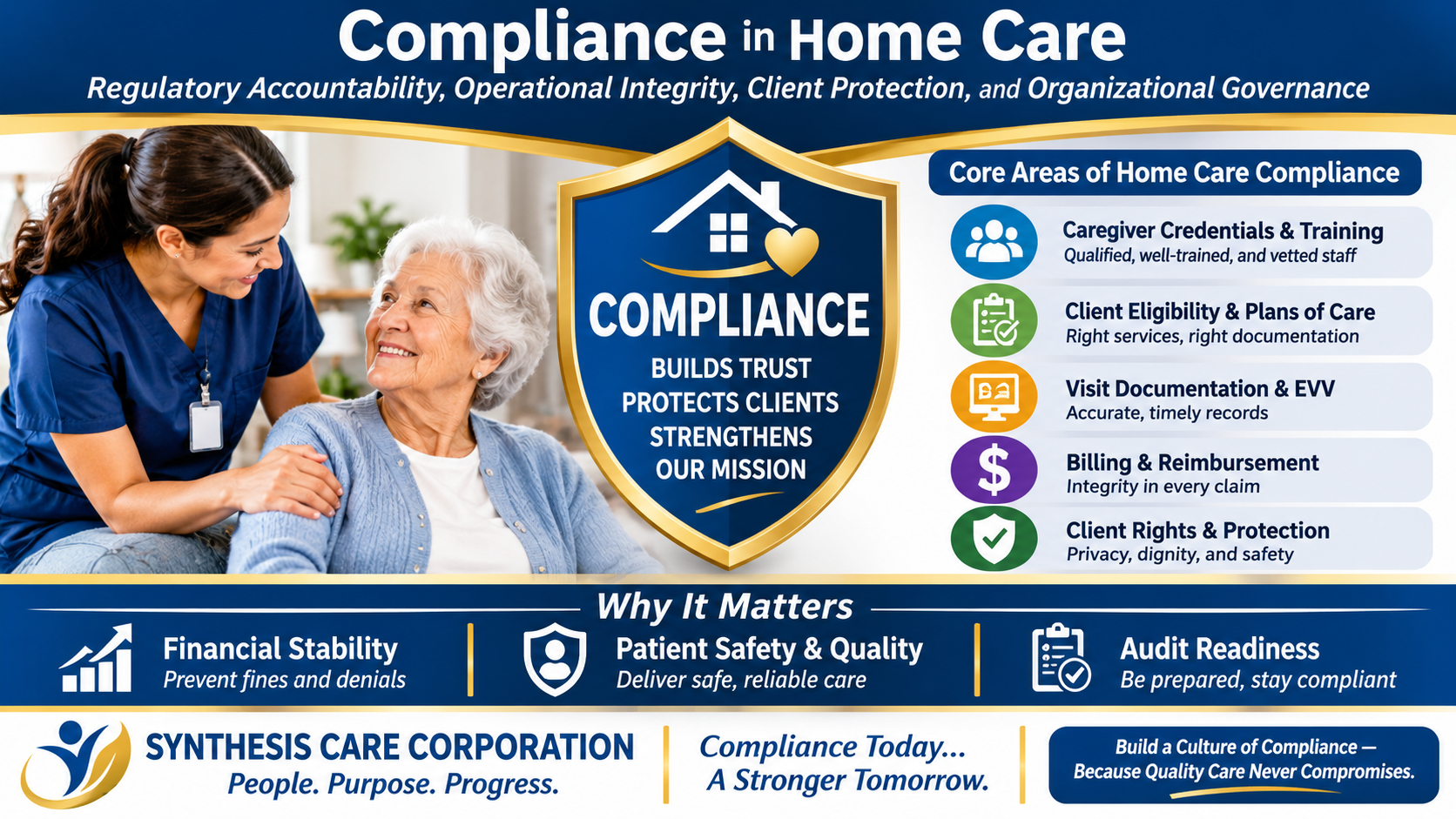
Summary
SYNTHESIS CARE CORPORATION
Document Classification: Corporate Research & Authoritative Guidance
Geographic Scope: United States — National Perspective
Publication Date: November 10, 2026
Edition: First Edition
Prepared by: Synthesis Care Corporation
EXECUTIVE SUMMARY
Home care compliance is the ongoing practice of ensuring that an organization operates in accordance with applicable federal, state, and local laws, licensing standards, regulatory requirements, payer obligations, and established organizational policies.
Compliance is not simply an administrative responsibility or a process reserved for regulatory inspections. It is a fundamental component of responsible organizational management and service delivery.
Home care organizations operate within a complex regulatory environment that can involve workforce qualifications, client eligibility, service authorization, documentation, electronic visit verification, billing practices, privacy protections, incident reporting, and quality oversight.
Failure to establish and maintain appropriate compliance practices can expose an organization to financial penalties, reimbursement denials, regulatory investigations, corrective action requirements, litigation, reputational damage, and potential harm to the individuals receiving services.
Importantly, the regulatory obligations of home care organizations are not identical.
Non-medical home care providers, personal care agencies, Medicare-certified home health agencies, and other healthcare providers may operate under different licensing classifications, regulatory standards, reimbursement arrangements, and oversight requirements.
Organizations must understand their specific classification and the requirements applicable to the services they provide.
This paper examines the fundamental components of home care compliance and establishes a national framework for understanding regulatory accountability, operational responsibilities, and organizational risk management.
1. UNDERSTANDING HOME CARE COMPLIANCE
Home care compliance is a continuous organizational process involving the identification, implementation, monitoring, and enforcement of applicable legal, regulatory, contractual, and operational requirements.
It encompasses several interconnected areas:
Federal, state, and local regulatory requirements.
Licensing and certification obligations.
Employee screening and qualification requirements.
Training and competency verification.
Client eligibility and service authorization.
Plans of care when applicable.
Visit documentation and service verification.
Electronic Visit Verification (EVV) when required.
Billing and reimbursement integrity.
Client rights and privacy protections.
Incident reporting and investigation.
Internal auditing and corrective action.
Organizational policies and management oversight.
Compliance requires more than maintaining written policies. Organizations must demonstrate that their procedures are implemented, communicated, monitored, and consistently followed.
An effective compliance framework should be incorporated into daily operations and organizational decision-making.
2. CORE AREAS OF HOME CARE COMPLIANCE
2.1 Caregiver Credentials, Screening, and Training
Personnel qualifications and workforce management are essential components of home care compliance.
Organizations must ensure that individuals performing services meet the applicable employment, screening, qualification, and training requirements associated with their assigned responsibilities.
Depending on the organization and service classification, requirements may include:
Criminal background checks.
Employment eligibility verification.
Professional license verification.
Required registry checks.
Health screenings where applicable.
Education and qualification verification.
Initial orientation and onboarding.
Mandatory training.
Continuing education where required.
Competency assessments.
Personnel record maintenance.
Organizations employing licensed healthcare professionals must establish procedures to verify professional credentials and monitor license status.
Personnel must perform duties within their authorized scope of practice, qualifications, and assigned responsibilities.
Training requirements differ across service classifications and jurisdictions. Organizations should maintain records demonstrating that applicable training and competency requirements have been satisfied.
Workforce compliance also includes applicable wage and hour laws, employee classification, workplace safety, and employment protections.
A properly structured personnel management system helps reduce operational risk while supporting consistent service delivery.
2.2 Client Eligibility, Service Authorization, and Plans of Care
Client eligibility and service authorization are important compliance considerations, particularly for organizations participating in Medicare, Medicaid, or other third-party reimbursement programs.
Organizations must determine whether the individual receiving services meets the applicable eligibility requirements and whether the services being delivered are authorized.
Depending on the provider classification and funding arrangement, responsibilities may include:
Verification of program eligibility.
Review of service authorization.
Documentation of assessed needs.
Establishment of appropriate service agreements.
Development of individualized care plans where required.
Physician or qualified practitioner orders when required.
Periodic review and revision of plans.
Documentation of changes in condition or service needs.
For Medicare-certified home health agencies, eligibility requirements include applicable homebound criteria, the need for qualifying skilled services, practitioner certification, and an established plan of care.
These requirements are specific to the Medicare home health benefit and must not be automatically applied to non-medical home care services.
Non-medical home care organizations should maintain appropriate documentation identifying the services requested, agreed-upon responsibilities, service limitations, and authorized arrangements.
The governing principle is that organizations must provide services consistent with their regulatory classification, contractual obligations, and authorized scope of practice.
2.3 Visit Documentation and Electronic Visit Verification
Accurate documentation is essential to establishing accountability for services delivered.
Organizations should maintain records that appropriately demonstrate:
The individual receiving services.
The personnel providing services.
The date and duration of services.
The location of service delivery when required.
The services performed.
Applicable service authorizations.
Relevant observations and communications.
Changes in service arrangements.
Incident documentation when applicable.
Documentation must be timely, accurate, complete, and consistent with the services actually provided.
Electronic Visit Verification (EVV)
Electronic Visit Verification is a technology-based method of confirming specified service visits.
Under Section 12006 of the 21st Century Cures Act, EVV requirements apply to specified Medicaid-funded personal care services and home health care services.
The six required EVV data elements are:
The individual receiving the service.
The individual providing the service.
The type of service performed.
The location of service delivery.
The date of service.
The beginning and ending times of service.
States administer EVV implementation through their applicable Medicaid programs and may establish additional operational requirements.
EVV requirements should not be represented as universally applicable to every privately funded home care visit.
Organizations must understand the requirements associated with their specific payer arrangements and applicable state implementation rules.
Technology can strengthen documentation and accountability, but an electronic record alone does not establish that a service was authorized, appropriately performed, or compliant.
2.4 Billing and Reimbursement Integrity
Billing compliance is a fundamental component of organizational financial accountability.
Organizations receiving reimbursement from Medicare, Medicaid, commercial insurers, or other third-party payers must understand the applicable billing, documentation, authorization, coding, and reimbursement requirements.
Core responsibilities include:
Accurate claims submission.
Verification of service eligibility.
Confirmation of authorization.
Appropriate service coding.
Documentation supporting billed services.
Accurate time and attendance records.
Prevention of duplicate billing.
Identification and correction of billing errors.
Appropriate handling of overpayments.
Maintenance of supporting financial records.
Claims must accurately represent the services delivered and satisfy applicable coverage and reimbursement requirements.
Submitting claims for services that were not provided, misrepresenting service delivery, or knowingly submitting inaccurate information can expose organizations to serious legal and financial consequences.
Relevant federal laws may include the False Claims Act, Anti-Kickback Statute, and Civil Monetary Penalties Law, depending on the circumstances.
Private-pay organizations also have financial compliance responsibilities, including accurate invoicing, transparent pricing, documented payment arrangements, appropriate payroll practices, and sound financial recordkeeping.
Financial integrity must be maintained regardless of the organization's reimbursement model.
2.5 Client Rights, Privacy, and Protection
Protecting the rights, dignity, privacy, and safety of individuals receiving home care services is a central compliance responsibility.
Organizations should establish policies and procedures addressing:
Respectful and nondiscriminatory treatment.
Client confidentiality.
Privacy and information security.
Informed service agreements.
Individual preferences.
Grievance procedures.
Abuse and neglect prevention.
Exploitation prevention.
Incident reporting.
Emergency response.
Continuity of services.
Appropriate communication with authorized representatives.
HIPAA and Confidentiality
The Health Insurance Portability and Accountability Act (HIPAA) establishes federal privacy and security requirements for covered entities and business associates.
Organizations subject to HIPAA must implement appropriate safeguards to protect protected health information.
These safeguards may include:
Administrative security procedures.
Physical safeguards.
Technical access controls.
Workforce training.
Confidentiality policies.
Security incident procedures.
Required business associate agreements.
Breach notification procedures.
Not every home care organization automatically qualifies as a HIPAA covered entity or business associate. Applicability depends on the organization's activities and relationships.
Nevertheless, protecting confidential client information should be an organizational priority regardless of whether HIPAA directly applies.
3. WHY HOME CARE COMPLIANCE MATTERS
Compliance serves several important organizational and public-interest functions.
3.1 Financial Stability
A properly maintained compliance framework helps organizations reduce financial exposure associated with:
Claim denials.
Payment delays.
Improper reimbursement.
Regulatory penalties.
Repayment demands.
Litigation.
Fraud allegations.
Contractual disputes.
Financial compliance also strengthens internal controls and supports sustainable organizational management.
3.2 Client Safety and Quality of Services
Compliance helps establish consistent expectations for personnel qualifications, service delivery, documentation, supervision, and incident management.
These controls support:
Safer service environments.
More reliable service delivery.
Appropriate personnel qualifications.
Better continuity of services.
Timely identification of potential risks.
Protection of client rights.
Organizational accountability.
Compliance cannot guarantee positive outcomes, but it provides an important framework for reducing preventable risks.
3.3 Audit and Regulatory Readiness
Home care organizations may be subject to regulatory inspections, payer audits, investigations, documentation requests, and other forms of oversight.
Organizations should maintain records demonstrating that their operations meet applicable requirements.
Audit readiness includes:
Current personnel files.
Screening and credential documentation.
Training records.
Service documentation.
Applicable authorizations.
Billing records.
Policies and procedures.
Incident reports.
Corrective action documentation.
Applicable licensing and certification records.
An organization should be able to demonstrate not only that policies exist, but also that those policies are implemented and followed.
4. DEVELOPING AN EFFECTIVE COMPLIANCE PROGRAM
An effective compliance program provides the organizational structure necessary to identify, monitor, and address regulatory and operational risks.
The U.S. Department of Health and Human Services Office of Inspector General identifies seven fundamental elements of an effective compliance program in its General Compliance Program Guidance.
These include:
Written policies, procedures, and standards of conduct.
Designated compliance leadership and oversight.
Effective education and training.
Effective lines of communication.
Monitoring and auditing.
Enforcement of standards and accountability.
Corrective action and continuous improvement.
These elements provide a useful framework for developing organizational compliance practices.
The OIG guidance is voluntary and nonbinding as general guidance. It does not replace specific legal or regulatory requirements.
Organizations should adapt their compliance programs to their size, structure, services, funding sources, and applicable regulatory obligations.
5. ORGANIZATIONAL ACCOUNTABILITY AND CONTINUOUS MONITORING
Compliance is not the responsibility of one employee or department alone.
Executive leadership must establish an organizational environment in which compliance responsibilities are clearly assigned and appropriately monitored.
An effective framework should identify:
Executive oversight.
Compliance leadership.
Operational management.
Workforce supervision.
Personnel record accountability.
Documentation oversight.
Financial controls.
Incident escalation procedures.
Internal audit responsibilities.
Corrective action procedures.
Organizations should periodically review their operations to identify deficiencies, evaluate emerging risks, and determine whether existing policies remain appropriate.
When deficiencies are identified, corrective actions should address the underlying causes rather than simply correcting individual records.
Continuous monitoring is particularly important because laws, regulations, payer requirements, and industry expectations can change.
6. TECHNOLOGY AND COMPLIANCE MANAGEMENT
Technology has become an important resource in supporting home care compliance.
Appropriately configured management systems can assist organizations with:
Personnel credential tracking.
Training documentation.
Scheduling and visit management.
Service records.
Timekeeping.
EVV integration where required.
Client documentation.
Incident management.
Billing reconciliation.
Compliance monitoring.
Audit preparation.
Management reporting.
Technology can improve visibility, consistency, and operational accountability.
However, technology does not independently establish regulatory compliance.
Organizations remain responsible for ensuring that their systems, workflows, personnel practices, data security measures, and documentation procedures meet applicable requirements.
A technology platform should support an established compliance framework, not serve as a substitute for one.
7. ESTABLISHING A CULTURE OF COMPLIANCE
The strongest compliance programs are supported by organizational culture.
Compliance should be reflected in management expectations, workforce training, operational procedures, and everyday decision-making.
Organizations should encourage personnel to:
Understand their responsibilities.
Follow established policies.
Protect confidential information.
Maintain accurate records.
Report concerns promptly.
Recognize potential safety risks.
Avoid unauthorized activities.
Cooperate with internal reviews.
Participate in required training.
Leadership should establish clear expectations and ensure that concerns are addressed consistently and appropriately.
An effective compliance culture encourages accountability before a problem develops into a regulatory or operational failure.
8. THE SYNTHESIS CARE CORPORATION POSITION
Synthesis Care Corporation recognizes compliance as a foundational requirement of responsible home care operations.
We believe that sustainable home care organizations must be built on regulatory awareness, operational integrity, accountability, and respect for the individuals and families they serve.
Compliance should not be approached as a checklist designed solely to satisfy an inspection or avoid financial penalties.
It should be integrated into the organization's operating structure.
We recognize that different home care classifications carry different legal and regulatory obligations. Non-medical home care, personal care, and skilled home health services must be evaluated according to their respective requirements.
Organizations must understand what services they are authorized to provide, what requirements govern those services, and what responsibilities they assume when entering into reimbursement or contractual arrangements.
Our corporate position is that responsible home care organizations should:
Understand their regulatory classification.
Maintain applicable licenses and certifications.
Operate within their authorized service scope.
Employ appropriately qualified personnel.
Maintain required screening and training records.
Protect client rights and confidential information.
Document services accurately.
Maintain appropriate financial controls.
Establish effective incident reporting procedures.
Conduct periodic internal reviews.
Demonstrate accountability through documented practices.
Compliance is not simply a regulatory obligation.
It is a measure of organizational responsibility.
CONCLUSION
The home care industry operates within a complex regulatory environment that demands consistent attention to legal obligations, operational procedures, workforce practices, financial integrity, and client protection.
Organizations that understand their responsibilities and establish effective compliance programs are better positioned to protect the individuals they serve, support their workforce, reduce organizational risk, and maintain sustainable operations.
Compliance must be continuously evaluated, appropriately documented, and incorporated into the organization's management structure.
It is not a one-time project, an annual exercise, or a task reserved for regulatory inspections.
Compliance is an ongoing organizational discipline and a fundamental component of responsible home care management.
AUTHORITATIVE REFERENCES AND REGULATORY RESOURCES
The following primary government resources provide additional information regarding federal regulatory requirements and compliance expectations.
1. Centers for Medicare & Medicaid Services (CMS)
Medicare Home Health Services — Provider Compliance Guidance
Provides information concerning Medicare home health eligibility, certification, medical necessity, plans of care, and documentation requirements.
2. U.S. Department of Health and Human Services — Office of Inspector General (HHS-OIG)
General Compliance Program Guidance
https://oig.hhs.gov/compliance/general-compliance-program-guidance/
Provides a framework for developing and maintaining effective healthcare compliance programs, including the seven fundamental elements.
3. U.S. Department of Health and Human Services — HIPAA
Covered Entities and Business Associates
https://www.hhs.gov/hipaa/for-professionals/covered-entities/index.html
Explains the organizations and relationships subject to HIPAA requirements.
4. Medicaid.gov
Electronic Visit Verification
Provides federal guidance concerning EVV requirements for specified Medicaid-funded personal care and home health services.
5. U.S. Department of Labor
Fact Sheet: Companionship Services and the Fair Labor Standards Act
https://www.dol.gov/agencies/whd/fact-sheets/79a-flsa
Explains federal wage and hour requirements applicable to companionship services and third-party employers.
6. Centers for Medicare & Medicaid Services
Home Health Agency Conditions of Participation
https://www.cms.gov/medicare/health-safety-standards/conditions-coverage-participation/home-health
Provides federal regulatory standards applicable to Medicare-certified home health agencies.
IMPORTANT PUBLICATION DISCLAIMER
This paper is intended for corporate education, industry research, and general regulatory awareness. It does not constitute legal advice, a legal opinion, or a determination that any particular organization satisfies applicable regulatory requirements.
Regulatory obligations vary according to service classification, jurisdiction, funding source, contractual arrangements, and organizational activities.
Federal guidance does not replace applicable statutes, regulations, state licensing requirements, local ordinances, or payer contracts.
Organizations should consult qualified legal and regulatory professionals when interpreting and implementing requirements applicable to their operations.
SYNTHESIS CARE CORPORATION
People. Purpose. Progress.
© 2026 Synthesis Care Corporation. All rights reserved.
Let's build