 Synthesis
Article · Technology
Human, AI and Home Care
Operating under Synthesis Home Care Operations, Guardian creates an intelligent, interconnected environment where technology, automation, and human expertise work together to transform how home care agencies are built, managed, and scaled.
Synthesis Care Corporation
Summary
Human, AI and Home Care
Where Human Expertise, Intelligent Automation, and Agentic AI Converge
A corporate research paper examining the operational transformation of home care agencies, the emerging capabilities of agentic conversational AI, and the security, governance, and human oversight required for responsible deployment.
Prepared by: Synthesis Care Corporation — Research & Strategy
Executive premise
The future of home care will not be determined solely by how many tasks an agency can automate. It will be determined by how effectively agencies integrate technology with human judgment, clinical expertise, caregiver relationships, and operational accountability.
Artificial intelligence is creating new opportunities to support administrative workflows, information management, communication, and operational coordination. However, the deployment of AI in home care introduces questions that cannot be answered through technology demonstrations alone:
What can AI reliably perform today, and what remains unproven?
What distinguishes an agentic conversational AI system from a conventional chatbot?
How should an agency manage an AI system capable of taking actions across operational workflows?
What security guardrails are necessary when systems interact with protected health information (PHI)?
How can agencies scale technology without compromising the human relationships at the center of care?
This paper approaches these questions from a corporate research perspective. It distinguishes established facts, documented regulatory requirements, emerging technical capabilities, and areas where further evidence is needed.
Research scope and evidence standard
The paper will examine the transformation of home care agencies across five operational dimensions:
Human expertise and care delivery.
AI-assisted administration and agency operations.
Agentic conversational AI and autonomous workflow execution.
Security, privacy, and governance.
A scalable technology adoption framework for home care agencies.
A central distinction is necessary: AI capability is not the same as demonstrated operational effectiveness. The paper will not present projected savings, staffing reductions, improved patient outcomes, or increased agency revenue as established facts unless supported by credible evidence.
Human, AI and Home Care
SYNTHESIS CARE CORPORATION | FEATURED RESEARCH
Abstract
The home care industry operates at the intersection of human service delivery, workforce coordination, regulatory responsibility, and increasingly complex administrative processes. As agencies expand, the operational burden associated with intake, scheduling, caregiver coordination, documentation, communication, and compliance can become a significant management challenge.
Artificial intelligence presents an opportunity to introduce new forms of operational support. Yet the emerging category of agentic AI introduces a different consideration: systems are no longer limited to answering questions or generating content. Depending on their architecture, permissions, and integrations, they may be capable of pursuing objectives through sequences of actions.
This paper examines the relationship between human expertise, conventional automation, and agentic conversational AI in home care. It considers documented capabilities, operational applications, limitations, cybersecurity risks, privacy obligations, and the guardrails necessary for responsible deployment.
The paper's central position is that AI should be treated as a governed operational capability rather than an independent substitute for care professionals. Its value must be established through measurable performance, controlled permissions, documented accountability, and demonstrated safety.
1. The Home Care Operating Environment
1.1 A human-intensive industry with growing operational demands
Home care is fundamentally different from many technology-driven service industries. The service is delivered in a person's home, often by caregivers working independently across geographically dispersed locations.
The operating environment may include:
Caregivers and direct support professionals.
Agency administrators and care coordinators.
Clients, families, and authorized representatives.
Referral sources and healthcare providers.
Scheduling, billing, payroll, and documentation systems.
Regulatory and payer requirements.
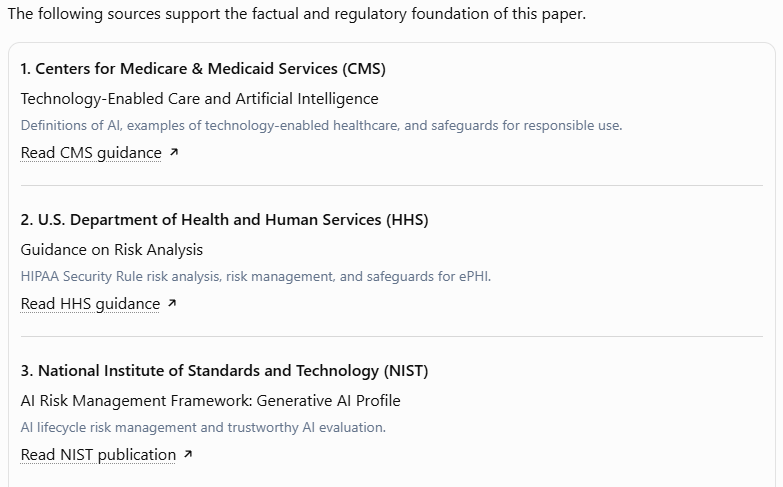
The workforce is substantial. The U.S. Bureau of Labor Statistics reported approximately 4.7 million jobs for home health and personal care aides in 2025. It projects employment in these occupations to grow 18% from 2025 to 2035, with approximately 760,500 openings annually over that period. These are national occupational estimates, not a forecast for any particular agency or state.
Bureau of Labor Statistics+1
This workforce context matters because technology adoption must be considered alongside the realities of recruiting, retaining, training, and coordinating people.
The strategic question is not whether technology can replace the human component of home care. It is how technology can improve the infrastructure supporting that human component.
1.2 The administrative operating burden
Home care agencies must coordinate a range of processes that are interconnected but often managed through different software applications, communication channels, and manual procedures.
These functions are not all suitable for automation to the same degree.
A system may be able to organize an intake record, but determining whether an individual meets clinical or program eligibility criteria may require qualified human judgment.
Likewise, an AI system may identify an apparent scheduling conflict, but resolving the conflict may require an administrator to consider caregiver qualifications, client preferences, continuity of care, and agency policies.
This distinction establishes the foundation for a responsible technology strategy.
2. Human Expertise, Automation, and Artificial Intelligence
2.1 Three distinct operating capabilities
The terms automation, artificial intelligence, and agentic AI are often used interchangeably. They describe different capabilities.
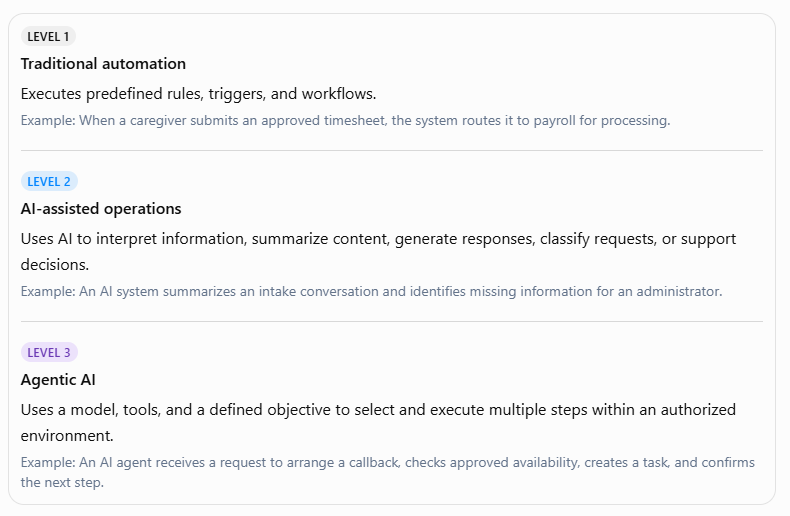
These categories describe functional differences, not a guaranteed progression in reliability.
An agentic system is not inherently more accurate than a conventional automation system. More autonomy can create additional failure modes because the system may take actions, access data, or interact with other systems.
The Centers for Medicare & Medicaid Services (CMS) describes AI as systems that can make predictions, recommendations, or decisions influencing real or virtual environments. CMS also identifies examples of technology-enabled healthcare applications, including virtual medical assistants that respond to routine inquiries and provide basic claim-status information.
CMS
These examples establish that AI-assisted healthcare administration is a recognized application area. They do not establish that every AI system can perform those tasks safely or effectively.
2.2 The human-AI operating model
The appropriate model for home care is a division of responsibilities.

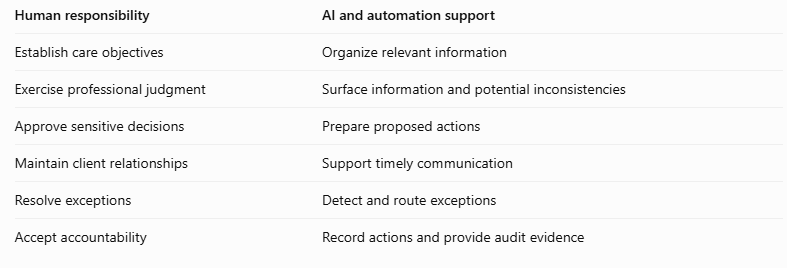
AI can support operational staff without transferring professional accountability to a software system.
For example, an AI system can prepare a draft caregiver assignment based on approved availability and qualifications. The agency's designated personnel remain responsible for determining whether the assignment is appropriate under applicable requirements.
This distinction becomes particularly important when technology interacts with client safety, clinical care, eligibility, or other consequential decisions.
2.3 What should remain human-led?
Synthesis Care Corporation recommends that agencies maintain human authority over decisions involving:
Clinical assessment and care-plan changes.
Diagnosis and treatment recommendations.
Emergency response decisions.
Determinations of client eligibility where professional judgment is required.
Decisions that materially affect a client's rights or access to care.
Resolution of ambiguous or conflicting information.
Final approval of high-impact operational actions.
This is a proposed governance standard, not a claim that every administrative task requires human approval.
The appropriate level of oversight depends on the nature of the task, applicable law, professional scope, and the potential consequences of error.
CMS explicitly emphasizes privacy protections, human oversight in care decisions, and ongoing monitoring of AI tools for accuracy and safety.
CMS
3. The Emergence of Agentic Conversational AI
3.1 Beyond the chatbot
A conventional chatbot is generally designed to respond to a user through a conversational interface. It may retrieve information, answer questions, or direct a user to a resource.
Agentic conversational AI introduces a different operating capability.
An agent may be designed to:
Interpret a request expressed in natural language.
Identify the objective and required information.
Retrieve information from authorized systems.
Determine which tools or workflows are available.
Execute permitted actions.
Verify the result.
Report completion or escalate an exception.
The defining distinction is not whether the system sounds intelligent or conversational.
The distinction is whether the system can use authorized tools to pursue an objective and take actions within a defined operational environment.
For example:
A caregiver might communicate:
"I am unable to make my scheduled shift tomorrow."
A chatbot might respond with the agency's call-off policy.
An agentic system, if appropriately integrated and authorized, could potentially:
Capture the call-off.
Identify the affected shift.
Confirm the caregiver's identity.
Retrieve the relevant scheduling record.
Create a coverage task.
Notify the appropriate coordinator.
Record the interaction.
Confirm that the request has been received.
Whether the system can actually perform these actions depends on the integrations, permissions, policies, and tested capabilities available to it.
The system should not claim that coverage has been arranged unless a qualified replacement has been confirmed.
3.2 The unknowns of agentic deployment
Agentic AI is an emerging operational category. The uncertainty is not simply whether an AI model can generate a convincing response. The more consequential questions concern how it behaves when connected to real systems.
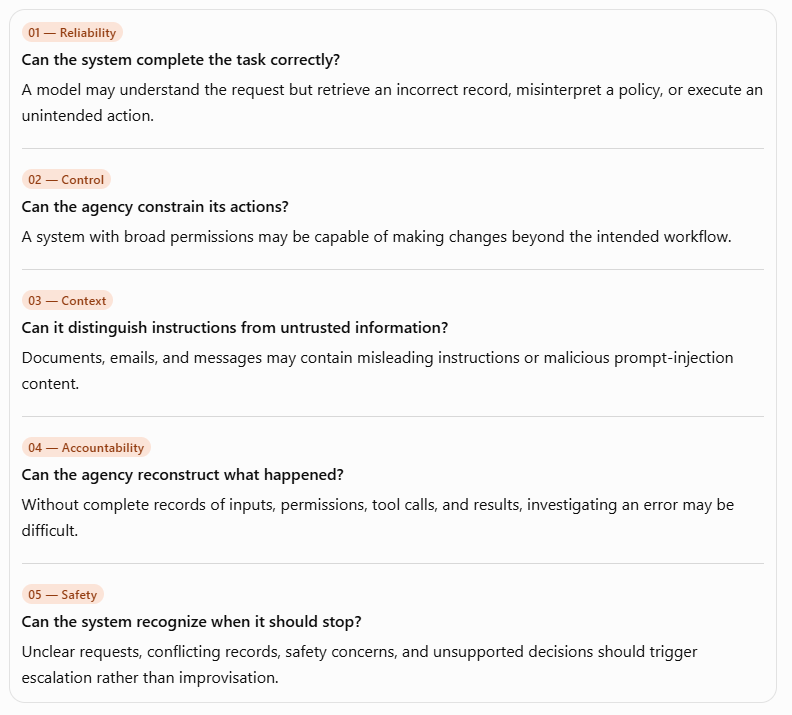
These are not hypothetical concerns invented for this paper. They correspond to established categories of AI risk, cybersecurity risk, and information-system governance.
NIST's AI Risk Management Framework and its Generative AI Profile provide resources for identifying, measuring, and managing risks associated with AI systems. NIST emphasizes evaluating AI systems before deployment and throughout their operational lifecycle.
NIST Publications+1
The available evidence does not justify treating agentic conversational AI as a universally reliable or independently accountable operator of home care agencies.
The appropriate approach is controlled deployment, with capabilities expanded only after evaluation.
4. Security Guardrails for Agentic AI in Home Care
4.1 Why security is different when AI can take action
A conventional software application typically performs operations defined by its code and user permissions.
An AI agent adds a layer of interpretation. It may decide which tools to invoke, what information to retrieve, and how to sequence operations.
This creates a distinct security concern: the AI system may be exposed to instructions that are ambiguous, incorrect, unauthorized, or malicious.
For a home care agency, the potential consequences extend beyond inaccurate answers. Depending on the connected systems and permissions, an AI agent could expose confidential information, alter records, send unauthorized communications, or initiate an inappropriate workflow.
A secure deployment must therefore protect both:
The information the AI can access.
The actions the AI can perform.
Security cannot be established through a disclaimer, a system prompt, or a promise that the model will behave responsibly.
It requires enforceable technical controls, operational policies, testing, and monitoring.
4.2 The guardrail architecture
Synthesis Care Corporation recommends a layered security model based on the principle of least privilege, explicit authorization, and human oversight.
Guardrail 1 — Identity and authentication
The system must establish who is making a request before accessing protected information or initiating sensitive actions.
Recommended controls:
Unique user identities.
Role-based access control.
Multi-factor authentication for appropriate users.
Identity verification before sensitive disclosures.
Session expiration and revocation.
Controls against impersonation.
A conversational system should not assume that a person is authorized simply because they know a client's name, address, caregiver, or schedule.
For example, a family member requesting a client's schedule must be authenticated and authorized under the agency's applicable policies before receiving that information.
Guardrail 2 — Least-privilege access
An AI agent should receive only the permissions required for its specific function.
A scheduling agent does not necessarily need access to clinical notes, payroll records, financial accounts, or an entire agency database.
Recommended implementation:
Restrict access by role, client, agency, and task.
Separate read permissions from write permissions.
Limit access to specific approved tools.
Use temporary or scoped authorization where feasible.
Prevent agents from granting themselves additional permissions.
Revoke access when the task or authorization ends.
The critical architectural principle is that the model should not be the final authority determining its own access.
Permissions must be enforced by the underlying systems.
Guardrail 3 — Human approval for high-impact actions
Not all AI actions should be executed automatically.
A recommended action classification is:
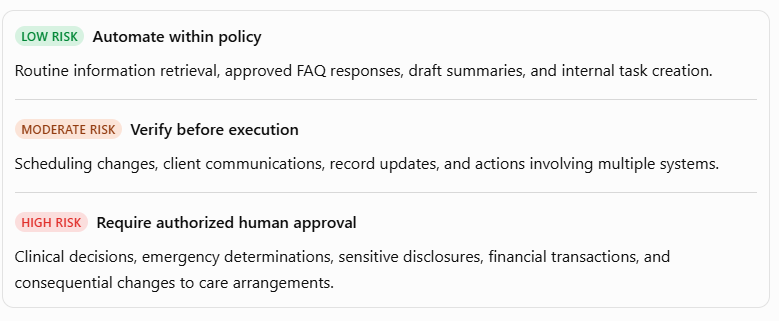
This is a proposed operational framework. Agencies should develop their own classification based on risk assessments and applicable requirements.
The system should be able to stop, request approval, or escalate rather than attempting to complete every request.
Guardrail 4 — Data protection and encryption
Electronic protected health information (ePHI) must be protected against reasonably anticipated threats to its confidentiality, integrity, and availability.
Recommended controls include:
Encryption in transit.
Encryption at rest.
Secure key management.
Data minimization.
Controlled retention and deletion.
Separation of agency data.
Secure backups and recovery procedures.
Restricted access to logs and recordings.
Encryption is important, but it does not eliminate the need for access controls, monitoring, or risk management.
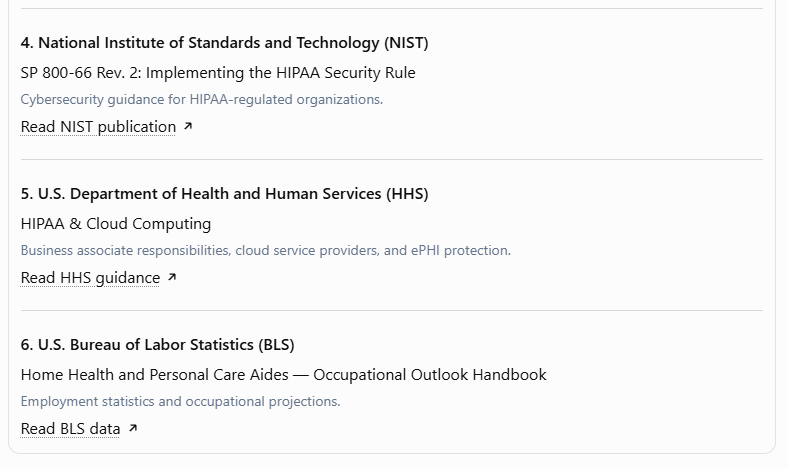
The U.S. Department of Health and Human Services (HHS) explains that HIPAA Security Rule compliance involves administrative, physical, and technical safeguards, supported by a risk analysis and risk management process.
HHS.gov+1
Guardrail 5 — Prompt injection and untrusted information
Agentic systems may retrieve information from documents, emails, websites, messages, or other external sources.
Those sources should be treated as untrusted inputs.
For example, a document could contain instructions that attempt to persuade an AI agent to disclose information or bypass its normal operating procedures.
Recommended controls:
Treat retrieved content as data, not authority.
Prevent external content from changing system permissions.
Restrict tool access independently of model instructions.
Validate inputs and outputs.
Use allowlisted tools and destinations.
Test prompt-injection resistance.
Require confirmation for sensitive actions.
An AI system should not be able to override agency policies merely because an instruction appears in a document or conversation.
Guardrail 6 — Auditability and accountability
A responsible AI system must produce sufficient evidence to reconstruct its actions.
Audit records should capture, where appropriate:
The identity or source of the request.
The authorized user or system.
The relevant workflow.
Data accessed.
Tools invoked.
Actions proposed and executed.
Approval decisions.
Errors and escalations.
Final outcomes.
Logs must themselves be protected because they may contain sensitive information.
The purpose of auditability is not simply to record AI activity. It is to support investigation, accountability, compliance, and operational improvement.
Guardrail 7 — Fail-safe behavior
An AI agent must have defined conditions under which it stops.
Examples include:
Identity cannot be verified.
Required information is missing.
Conflicting records are detected.
The requested action exceeds permissions.
A system integration fails.
A safety concern is identified.
The model cannot establish a reliable answer.
The system should not invent a completion status or continue through an unsafe workflow.
A fail-safe design should support escalation to a designated human operator and provide a clear record of what remains unresolved.
Guardrail 8 — Continuous monitoring and testing
AI systems may change behavior when models, prompts, integrations, data sources, or workflows are modified.
Testing should therefore extend beyond initial deployment.
Recommended evaluation areas:
Task completion accuracy.
Incorrect actions and unintended changes.
Data-access violations.
Unauthorized disclosures.
Prompt-injection resistance.
Escalation accuracy.
Reliability under integration failures.
User complaints and operational incidents.
A system that performs well during a limited demonstration has not necessarily demonstrated production reliability.
5. HIPAA, Privacy, and Regulatory Responsibilities
5.1 HIPAA is a system-level responsibility
A critical distinction must be made between a vendor claiming that its AI product is "HIPAA compliant" and an agency establishing that its actual deployment complies with applicable HIPAA requirements.
HIPAA obligations depend on the parties, the information involved, the services provided, and the configuration of the system.
HHS explains that a cloud service provider that creates, receives, maintains, or transmits ePHI on behalf of a covered entity or business associate may qualify as a business associate. A HIPAA-compliant business associate agreement (BAA) is required where applicable. This remains true even when the provider stores encrypted ePHI without possessing the decryption key.
HHS.gov+1
This has direct implications for agentic AI deployments.
If an AI provider, integration vendor, cloud service, transcription provider, or other subcontractor handles ePHI, the agency must evaluate the applicable contractual and regulatory requirements.
The evaluation should include:
Whether the vendor is a covered entity or business associate.
Whether a BAA is required.
Whether subcontractors are involved.
What data the system processes.
Where information is stored and transmitted.
How data is retained and deleted.
What happens after termination.
How security incidents are reported.
What safeguards are implemented and who is responsible.
HHS also clarifies that it does not endorse or certify specific cloud products as HIPAA compliant.
HHS.gov+1
5.2 Data use and AI model training
Agencies should not assume that information submitted to an AI platform is automatically protected from secondary use.
Before deployment, the agency should establish:
Whether customer data is used to train or improve models.
Whether data is retained after the interaction.
Whether the provider or its subcontractors can access the information.
Whether data is used for purposes beyond the contracted service.
Whether the configuration supports the agency's privacy obligations.
The applicable answer must be established through vendor documentation, contracts, configuration, and legal review.
A general consumer AI service should not be treated as an approved environment for PHI merely because the service is commercially available.
CMS's internal guidance provides an example of a restrictive approach: it instructs CMS personnel not to disclose PII, PHI, or sensitive CMS information into publicly accessible generative AI tools. This is CMS policy for its own personnel, not a universal prohibition applicable to every healthcare organization.
CMS Information Security and Privacy Program
5.3 Privacy extends beyond written records
Agentic conversational AI may use voice, text, and other forms of interaction.
Agencies should consider:
Recording and transcription policies.
Appropriate notice and consent.
Identity verification.
Secure storage of transcripts.
Access to conversation histories.
Retention periods.
Use of sensitive information in model context.
Applicable state privacy and recording laws.
A voice interaction can contain the same sensitive information as a written medical record.
The fact that information is communicated conversationally does not remove the need to protect it.
5.4 Clinical decision support and scope of practice
An AI system used for administrative support is not necessarily regulated in the same way as a software product intended to provide clinical decision support.
The intended use of the system, its functionality, and the applicable regulatory framework matter.
An agency should not assume that a system is outside FDA oversight simply because it uses a conversational interface or is marketed as an administrative assistant.
Likewise, AI-generated information should not be used to bypass professional licensure, scope-of-practice, or care-plan requirements.
CMS identifies HIPAA, FDA safety standards, applicable clinical licensure, and scope-of-practice rules among the safeguards relevant to technology-enabled care.
CMS
6. The Synthesis Care Corporation Technology Adoption Framework
6.1 Technology should be adopted through controlled stages
Synthesis Care Corporation recommends that agencies avoid deploying AI across every operational function simultaneously.
A staged approach allows the agency to establish baseline performance, evaluate risk, and expand capabilities using evidence.
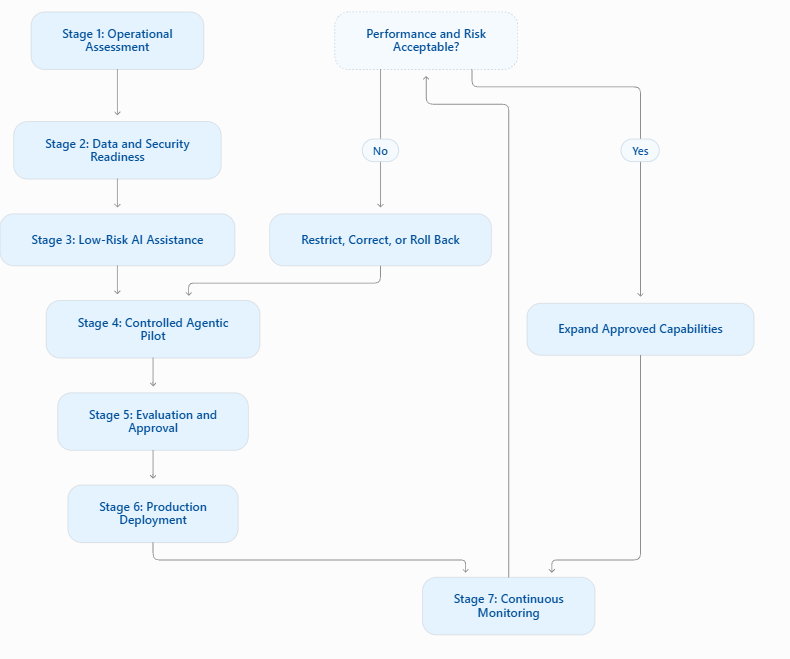
Stage 1 — Operational assessment
The agency identifies its current processes, systems, and operational challenges.
The objective is to determine where technology could address an actual business need rather than introducing AI for its own sake.
Recommended activities:
Map existing workflows.
Identify repetitive tasks.
Document process owners.
Establish baseline performance.
Identify existing software and integrations.
Assess current failure points.
Stage 2 — Data and security readiness
Before introducing AI into operational systems, the agency establishes the necessary security and governance foundations.
This includes:
Data classification.
Risk assessment.
Vendor review.
Access-control design.
Contract and BAA review, where applicable.
Incident-response procedures.
Data-retention requirements.
Staff training.
Stage 3 — Low-risk AI assistance
The agency begins with tasks that can be evaluated without allowing the AI to make consequential changes independently.
Examples include:
Drafting internal communications.
Summarizing non-sensitive operational information.
Organizing approved policy documents.
Preparing intake summaries for human review.
Creating draft checklists.
Assisting with routine administrative questions.
The agency should establish measurable acceptance criteria before deployment.
Stage 4 — Controlled agentic pilot
A limited pilot introduces an AI agent into a defined workflow.
A suitable initial use case may be an administrative intake process that collects information, identifies missing fields, and creates a review task.
The pilot should have:
A clearly defined objective.
A limited set of authorized tools.
A documented permission model.
A designated human owner.
An escalation process.
A testing protocol.
A rollback procedure.
The system should not be granted broad access to agency operations simply because it has performed well in a narrow pilot.
Stage 5 — Evaluation and approval
The agency evaluates the pilot against predefined criteria.
The decision to proceed should be based on evidence, including performance, reliability, security, staff feedback, and operational impact.
A successful pilot is not merely one that demonstrates that an AI agent can complete a task.
It is one that demonstrates the task can be completed within acceptable risk boundaries.
Stage 6 — Production deployment
Once approved, the system is deployed with documented controls and assigned ownership.
Production deployment should include:
Formal approval.
Documented system configuration.
User training.
Monitoring.
Incident-response readiness.
Change management.
Defined service expectations.
Stage 7 — Continuous monitoring
The agency periodically reassesses whether the AI system remains appropriate.
This includes reviewing model changes, workflow changes, integrations, security incidents, and observed performance.
The deployment should be treated as an ongoing operational responsibility rather than a one-time software installation.
7. Where Agentic AI May Support Home Care Operations
The following opportunities are presented as areas for evaluation, not claims of guaranteed results.
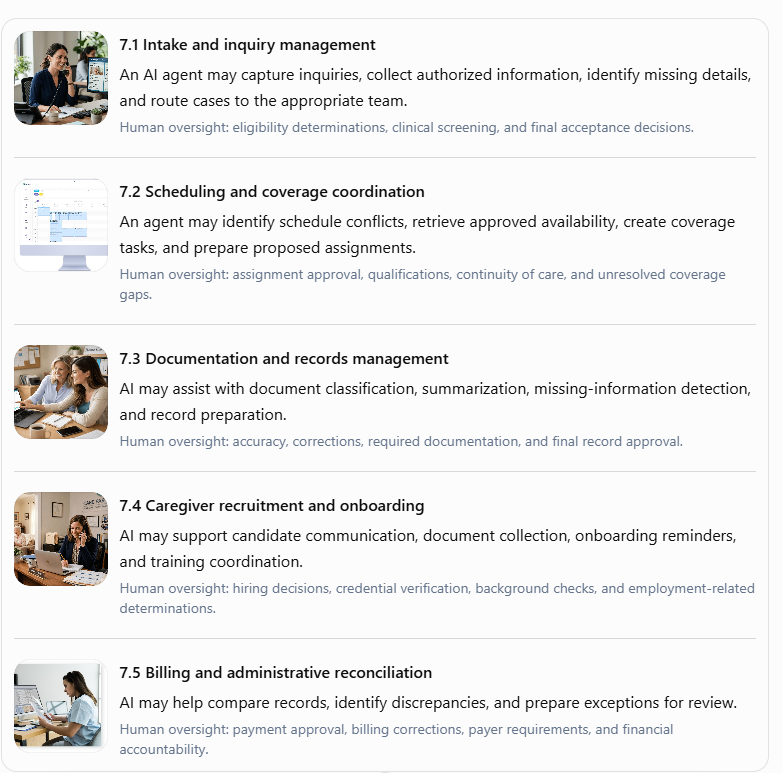
These applications should be prioritized according to the agency's actual operational requirements.
An intake agent, for example, may be a better initial deployment than a clinical-facing agent because its permitted actions can be more narrowly defined.
However, the risk classification must reflect the real data and actions involved, not simply the label assigned to the use case.
7.6 The potential for a unified care operations system
One longer-term opportunity is the integration of AI-supported workflows into a unified agency operating environment.
Such an environment could connect:
Intake and screening.
Scheduling.
Caregiver management.
Client and family communication.
Documentation.
Billing and payroll.
Compliance.
Operational reporting.
The strategic value of integration is that the agency could reduce unnecessary handoffs between disconnected processes.
However, integration does not automatically produce efficiency. It may also increase the impact of a failure if permissions, data quality, and system dependencies are poorly managed.
The design principle should therefore be:
Connected operations, controlled autonomy, and accountable human oversight.
8. Measuring Performance: From AI Adoption to Operational Evidence
An agency should not evaluate AI solely by the number of tasks completed or the volume of conversations handled.
A system may process thousands of interactions while producing errors that create additional work or risk.
Synthesis Care Corporation recommends measuring performance across four categories.
8.1 Operational performance
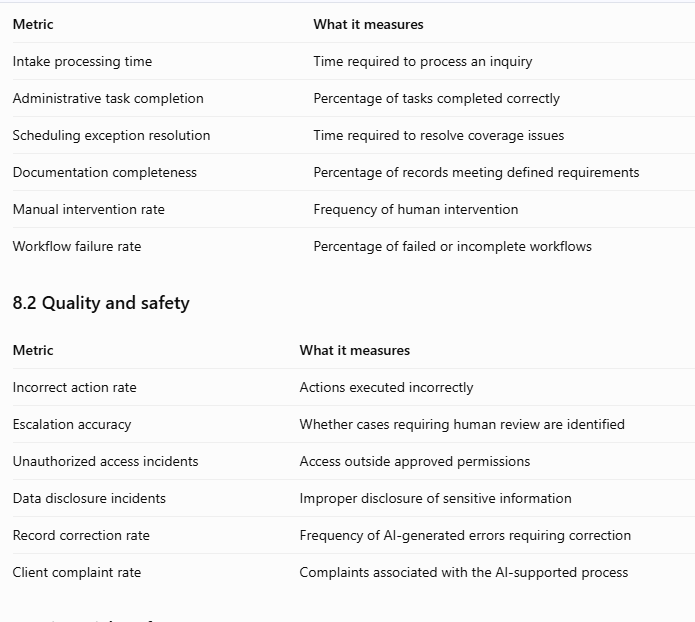
8.3 Financial performance
Financial analysis should distinguish between measurable savings and theoretical productivity improvements.
Relevant measures include:
Cost per completed administrative task.
Cost of human review.
Software and integration costs.
Training and implementation costs.
Ongoing monitoring and compliance costs.
Cost of errors and rework.
Net operating impact.
A reduction in processing time does not necessarily equal a reduction in payroll expense.
Likewise, increased administrative capacity does not necessarily translate into additional revenue.
Those outcomes require separate evidence.
8.4 Human and organizational performance
AI adoption should also be evaluated through the experience of the people using it.
Relevant indicators include:
Staff satisfaction.
Training completion.
User confidence in system outputs.
Caregiver communication quality.
Client and family feedback.
Escalation workload.
Changes in administrative responsibilities.
The objective should be to establish whether the system improves the agency's ability to operate responsibly, not merely whether it introduces more technology.
9. The Strategic Implications for Home Care Agencies
9.1 Technology adoption is becoming an operational competency
The ability to evaluate, implement, govern, and maintain technology may become an increasingly important management competency for home care agencies.
Agencies will need to understand more than software features.
They will need to understand:
Their own operational workflows.
The limitations of AI systems.
Data protection requirements.
Integration dependencies.
Vendor responsibilities.
Security architecture.
Human oversight.
Performance measurement.
This does not mean that every agency must develop its own AI models or cybersecurity infrastructure.
It means that agencies must be able to make informed decisions about the technology they adopt and the responsibilities that accompany it.
9.2 The opportunity is not simply to automate tasks
The more significant opportunity is to improve how an agency coordinates its operations.
A well-governed AI system may assist with information gathering, workflow preparation, task routing, exception identification, and communication.
Traditional automation can execute predictable processes.
AI can support the interpretation of less structured information.
Agentic systems may connect those capabilities by taking authorized actions across multiple steps.
Human professionals remain responsible for the decisions and relationships that require judgment, expertise, and accountability.
The opportunity is therefore not a choice between human care and artificial intelligence.
It is the development of an operating model in which each is used appropriately.
9.3 The unknown must remain part of the strategy
The rapid development of agentic AI does not eliminate the need for evidence.
Agencies should remain cautious about claims that AI will independently manage complex care operations, eliminate administrative labor, improve clinical outcomes, or guarantee regulatory compliance.
Those claims require specific evidence.
The appropriate approach is to evaluate capabilities as they become available, establish operational controls, and expand adoption only when results support the decision.
10. Conclusion
Human expertise remains the foundation. AI becomes the operational capability.
Home care is a human-centered industry operating within a complex administrative and regulatory environment.
Artificial intelligence offers opportunities to support the processes surrounding care delivery. Agentic conversational AI introduces additional possibilities by allowing systems to interpret requests, use authorized tools, and execute sequences of operational actions.
These capabilities also introduce risks that require deliberate governance.
The responsible deployment of AI in home care must be grounded in security, privacy, reliability, and accountability. Agencies must understand what their systems can access, what actions they can take, when they must stop, and who remains responsible for the outcome.
The future of home care technology will not be determined by autonomy alone.
It will be determined by the ability to combine technological capability with human expertise and operational discipline.
Synthesis Care Corporation's position is that AI should strengthen the infrastructure supporting care, not diminish the human responsibility at its center.
The objective is not to remove the human from home care. It is to create an operating environment in which human expertise can be supported by intelligent, secure, and accountable technology.
Let's build