 Synthesis
Research Series No. 1 · A Comprehensive Guide to Building a Home Care Business
From Care Professional to Agency Owner
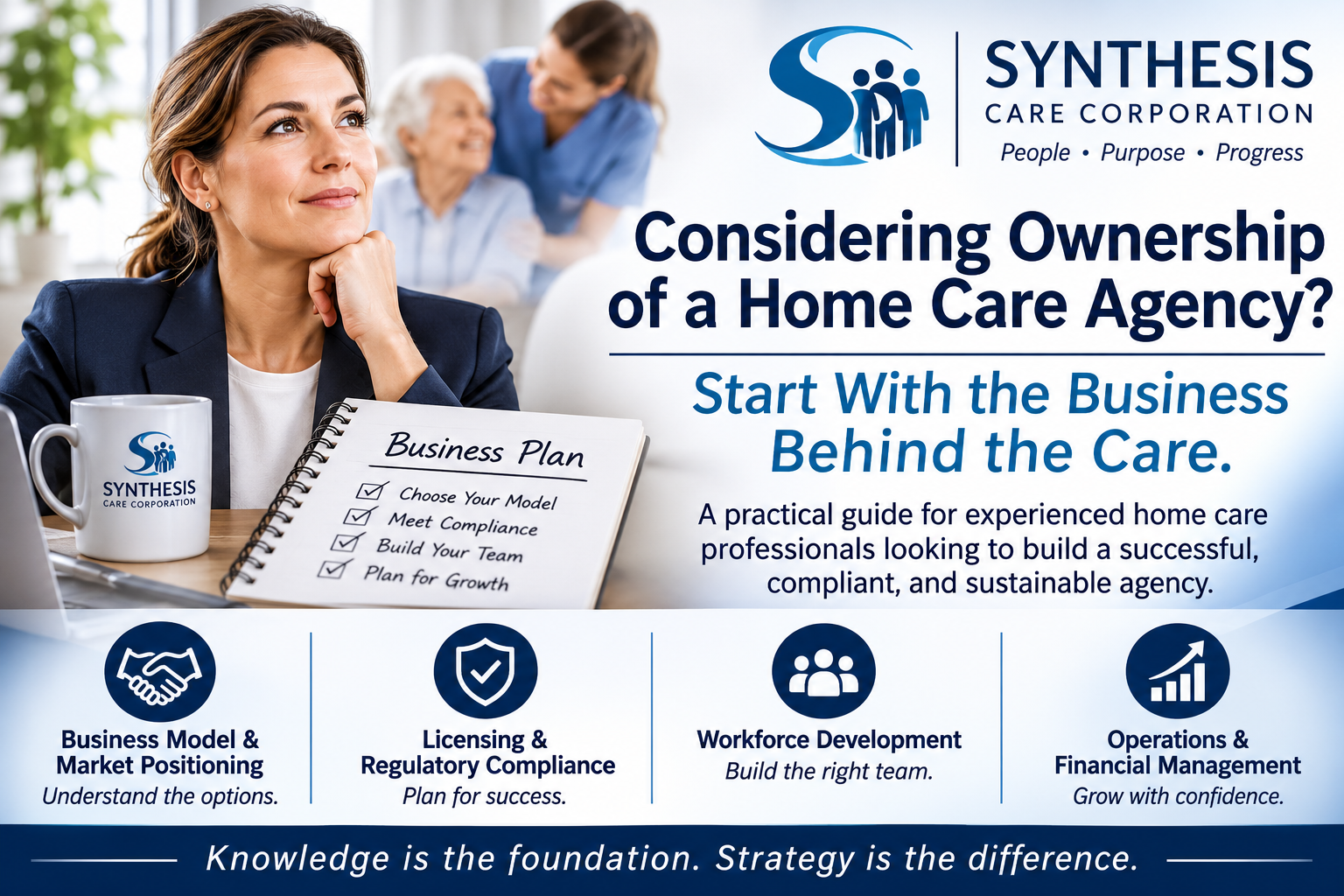
A Comprehensive Guide to Building a Home Care Business. Understanding the Business Behind the Care
Synthesis Care Corporation
Summary
The home care industry provides opportunities for experienced professionals to turn their knowledge of care delivery into an independently operated business. Many individuals working in the industry have firsthand experience with client needs, workforce challenges, service delivery, and the operational shortcomings that can affect care organizations.
That experience can provide a valuable foundation for agency ownership.
However, operating a home care agency requires a different set of competencies than providing care. Business formation, licensing, regulatory compliance, workforce management, financial planning, operational procedures, and client acquisition all play a role in determining whether an agency can operate successfully.
An agency is not established simply by registering a business name, hiring employees, and finding clients. It requires an organized business structure, a defined service model, documented operating procedures, appropriate regulatory authorization, and the financial resources to sustain operations.
This guide examines the major decisions and responsibilities involved in establishing a home care agency, from initial business formation through the first year of operation.
The objective is to provide prospective owners with a clearer understanding of what it takes to build an organization that is compliant, financially responsible, operationally sound, and positioned for sustainable growth.
1. Establishing the Business Foundation
Before beginning the licensing process or recruiting employees, prospective owners should establish the legal and financial foundation of the business.
These early decisions affect ownership, taxation, liability, financial management, and the organization's ability to grow.
Choosing a Business Structure
One of the first decisions is determining how the agency will be legally organized.
Common business structures include:
Limited Liability Company (LLC)
An LLC is a popular structure for small and privately owned businesses. It generally provides liability protection for owners while offering flexibility in management and taxation.
An LLC may have one owner or multiple members. Its operating agreement should establish ownership interests, management responsibilities, financial arrangements, and procedures for resolving disputes.
C Corporation
A C Corporation is a separate legal entity owned by shareholders. It has a formal governance structure, including directors, officers, and shareholders.
This structure may be appropriate for businesses anticipating outside investment, multiple ownership interests, or a more formal corporate structure. It also introduces additional administrative and tax considerations.
S Corporation Tax Election
An S Corporation is not a separate state-law business entity in the same sense as an LLC or corporation. It is a federal tax election available to qualifying entities.
For example, an LLC may elect S Corporation taxation if it meets applicable requirements.
The decision should be evaluated with an accountant or tax professional because compensation, payroll, distributions, and tax obligations can differ significantly.
Other Structures
Sole proprietorships and partnerships may also be considered, depending on ownership and business objectives. However, their liability and governance characteristics should be carefully evaluated.
The appropriate structure depends on the owner's financial circumstances, ownership plans, risk exposure, and long-term objectives.
Business Registration and Administrative Requirements
Once the legal structure is selected, the owner should address the necessary administrative requirements, which may include:
Registering the business with the appropriate state agency.
Obtaining an Employer Identification Number (EIN).
Registering applicable state and local tax accounts.
Establishing a business bank account.
Creating an operating agreement or corporate bylaws.
Establishing accounting and bookkeeping procedures.
Obtaining required business licenses and permits.
Establishing a registered agent where required.
Securing appropriate business insurance.
Owners should maintain a clear separation between personal and business finances.
Business revenue should flow through business accounts, and business expenses should be properly documented. This supports accurate financial reporting, tax preparation, and accountability.
Developing a Business Plan
A business plan should establish how the agency intends to operate and generate revenue.
At a minimum, it should address:
Target population and service area.
Competitive market analysis.
Services offered.
Pricing and reimbursement strategy.
Staffing requirements.
Startup expenses.
Monthly operating expenses.
Revenue projections.
Marketing and client acquisition.
Financial reserves and break-even expectations.
A business plan is not simply a document prepared to obtain financing. It should function as a management tool for evaluating business decisions and measuring performance.
2. Choosing the Agency's Service and Payment Model
One of the most consequential decisions is determining what type of home care organization the owner intends to establish.
Non-medical home care and skilled home health are different business models. They have different service requirements, professional responsibilities, licensing considerations, staffing needs, and reimbursement structures.
Prospective owners should understand these distinctions before selecting a business model.
Non-Medical Home Care
Non-medical home care agencies generally provide assistance that helps individuals remain safely and comfortably in their homes.
Depending on state authorization, services may include:
Companionship and supervision.
Assistance with activities of daily living.
Personal care and hygiene assistance.
Meal preparation.
Light housekeeping.
Transportation and errands.
Medication reminders, where permitted.
Assistance with instrumental activities of daily living.
Owners must understand the boundaries of non-medical service delivery. Services requiring licensed clinical professionals cannot simply be added to a non-medical service offering without the appropriate authorization and qualified personnel.
Skilled Home Health
Home health agencies provide medically necessary services under applicable clinical and regulatory requirements.
Depending on the agency's authorization and staffing, services may include:
Skilled nursing.
Physical therapy.
Occupational therapy.
Speech-language pathology.
Medical social services.
Home health aide services associated with qualifying home health plans of care.
Agencies pursuing Medicare certification must satisfy applicable federal participation requirements, including the Medicare Home Health Conditions of Participation.
This is a substantially different operational undertaking from establishing a private-pay, non-medical home care agency.
Understanding Payment and Reimbursement Models
The agency's payment model should be established early because it influences pricing, cash flow, billing procedures, documentation, and client acquisition.
Private Pay
Clients or their families pay directly for services.
The agency establishes its service rates, billing arrangements, payment schedules, and contractual terms.
Private-pay operations generally provide more direct control over pricing and service arrangements, subject to applicable laws and regulations.
Long-Term Care Insurance (LTC)
Some clients have long-term care insurance policies that provide benefits for qualifying home care services.
However, coverage is not automatic. Policies may contain specific requirements involving:
Benefit eligibility.
Activities of daily living limitations.
Cognitive impairment provisions.
Elimination periods.
Approved service categories.
Provider qualifications.
Documentation and claim submission.
An agency should understand what documentation clients may need and whether the agency meets the policy's provider requirements.
Medicare
Medicare should not be confused with a general payment source for non-medical custodial home care.
Medicare covers qualifying home health services under specific conditions, including requirements involving skilled care, homebound status, practitioner oversight, and an appropriate plan of care.
Medicare does not generally pay for ongoing custodial or personal care when that is the only care needed.
Agencies considering Medicare participation must understand the certification, enrollment, clinical, documentation, billing, and compliance responsibilities involved.
Medicaid
Medicaid may provide payment for qualifying home and community-based services, personal care, and certain home health services through state plans and waiver programs.
Requirements vary by state and program.
Agencies may need separate provider enrollment, program approval, contracts, authorization procedures, and compliance with state-specific billing and documentation rules.
For Medicaid-funded personal care and home health services covered by federal EVV requirements, states must implement electronic visit verification.
The Business Decision
Owners should not select a payment model based solely on the potential size of the market.
They should evaluate reimbursement rates, administrative costs, payment timelines, eligibility requirements, documentation responsibilities, and the financial resources needed to operate while waiting for reimbursement.
3. State Licensing and Regulatory Compliance
Business registration does not automatically authorize an organization to operate a home care agency.
Home care licensing requirements differ across the United States. Some states regulate non-medical home care agencies through specific licensing or registration programs, while others establish different requirements based on service categories and business activities.
A prospective owner must research the requirements of the state in which the agency intends to operate.
Understanding State Licensing Requirements
Before submitting an application, owners should identify:
Which state agency regulates the intended service model.
Whether an agency license or registration is required.
Whether the owner or administrator must meet specific qualifications.
Whether a physical office is required.
What application fees apply.
Whether background checks are required.
What insurance coverage must be maintained.
What policies and procedures must accompany the application.
Whether an initial inspection is required.
Whether there are restrictions on advertising or service delivery before approval.
Some states require detailed documentation before granting authorization.
Others may require additional steps involving inspections, administrator training, financial information, or proof of operational readiness.
Employee Screening and Qualification Requirements
Agencies should establish a documented process for determining whether employees meet applicable requirements.
Depending on state law and the services provided, this may involve:
Criminal background checks.
Registry checks.
Employment verification.
Reference checks.
Identity and work authorization verification.
Required education and training.
Competency assessments.
Professional license verification, where applicable.
Screening requirements should be established before employees are assigned to clients.
Client Rights and Regulatory Responsibilities
Agencies must understand their responsibilities concerning:
Client rights and informed consent.
Service agreements.
Confidentiality.
Complaint resolution.
Incident reporting.
Abuse, neglect, and exploitation reporting.
Documentation and record retention.
Emergency preparedness.
Required supervision.
Regulatory inspections and reporting.
HIPAA applicability should also be evaluated rather than assumed. Certain healthcare providers and business associates must comply with HIPAA, but not every organization providing non-medical services automatically qualifies as a covered entity.
Agencies should determine their obligations based on their actual business activities and relationships.
Licensing Timelines and Financial Planning
Licensing timelines can vary significantly.
Application processing, background checks, inspections, requests for additional documentation, and state administrative procedures may affect the time required to obtain approval.
Owners should avoid committing to a launch date based solely on an estimated processing period.
A realistic startup budget should include operating expenses during the licensing period, even when the business is not yet generating revenue.
Important: Never advertise, accept clients, or provide regulated services before obtaining the authorization required by the applicable jurisdiction.
4. Establishing Policies, Procedures, and Standard Operating Procedures
One of the most overlooked aspects of agency development is the creation of a formal operational framework.
A home care agency cannot depend entirely on the owner to make every decision, resolve every scheduling issue, manage every employee, and oversee every client relationship.
The organization needs documented procedures that establish how work is performed.
These are commonly referred to as Standard Operating Procedures (SOPs).
Why SOPs Matter
SOPs create consistency, accountability, and operational continuity.
They help employees understand their responsibilities and provide management with a defined process for monitoring performance.
Without documented procedures, agencies may experience inconsistent service delivery, missed communications, incomplete records, scheduling problems, billing errors, and avoidable compliance risks.
SOPs should be developed around the actual services offered and the applicable state requirements.
Core Operational Policies and Procedures
A. Client Intake and Onboarding
The agency should establish procedures for:
Receiving and documenting inquiries.
Conducting an appropriate needs evaluation.
Determining whether requested services fall within the agency's scope.
Establishing service eligibility.
Obtaining required authorizations.
Preparing service agreements.
Documenting client preferences.
Establishing emergency contacts.
Matching personnel to client needs.
Communicating service expectations.
B. Employee Recruitment and Hiring
Documented procedures should address:
Job descriptions.
Recruiting and interviewing.
Background screening.
Reference verification.
Employment eligibility.
Compensation arrangements.
Employee agreements.
Orientation.
Required training.
Personnel record management.
C. Scheduling and Workforce Management
Scheduling procedures should establish:
How assignments are created.
How shifts are confirmed.
How attendance is recorded.
How call-offs are handled.
How replacement personnel are assigned.
How late arrivals are addressed.
How missed visits are documented.
How scheduling changes are communicated.
D. Service Delivery and Documentation
The agency should define expectations for:
Arrival and departure documentation.
Service records.
Client communication.
Changes in client condition.
Unusual events.
Missed or incomplete services.
Supervisor notifications.
Record completion and review.
E. Emergency and Incident Management
Written procedures should address:
Medical emergencies.
Falls and injuries.
Suspected abuse or neglect.
Missing clients.
Environmental hazards.
Employee injuries.
Service interruptions.
Emergency contacts.
Escalation and reporting.
F. Billing and Financial Procedures
The agency should document:
Service authorization.
Time verification.
Invoice preparation.
Payment processing.
Outstanding balances.
Refunds and adjustments.
Payroll approval.
Expense reimbursement.
Financial reconciliation.
G. Quality Assurance
Quality assurance should include:
Periodic record reviews.
Client satisfaction monitoring.
Employee performance evaluations.
Complaint tracking.
Incident trend analysis.
Corrective action procedures.
Management reporting.
Creating an Agency Policy and Procedure Manual
An agency should develop a centralized policy and procedure manual that organizes its operational requirements.
The manual should be reviewed against state licensing rules and updated when regulations, services, or business operations change.
A useful manual should identify:
Policy title and purpose.
Scope of application.
Responsible personnel.
Required procedures.
Documentation requirements.
Escalation responsibilities.
Review and revision dates.
Policies should not exist simply to fill a binder. Employees must receive appropriate training, and management must verify that the procedures are followed.
5. Recruiting, Developing, and Retaining the Workforce
The workforce is one of the agency's most important operational resources.
Recruitment alone does not create a reliable staffing structure. Agencies must develop processes for hiring, training, scheduling, supervising, and retaining qualified personnel.
Workforce Planning
Before recruiting, owners should determine:
How many employees are needed.
Which positions must be filled.
What qualifications each position requires.
How many clients the agency can realistically serve.
How staffing coverage will be maintained.
What management and administrative support is necessary.
Hiring should be aligned with projected client demand and available working capital.
Recruitment and Hiring
Agencies should develop consistent recruiting practices that include:
Clear job descriptions.
Defined qualifications.
Structured interviews.
Appropriate background screening.
Reference verification.
Written employment terms.
Orientation and onboarding.
Employee Training and Development
Training should address both job responsibilities and agency procedures.
Depending on the position and applicable state requirements, training may include:
Client rights.
Confidentiality.
Infection prevention.
Safety practices.
Emergency procedures.
Documentation.
Communication.
Professional conduct.
Scope-of-service limitations.
Incident reporting.
Compensation and Employment Compliance
Owners must understand applicable federal and state employment laws.
These include requirements involving minimum wage, overtime, payroll records, employee classification, and other employment obligations.
Agencies should not assume that calling a worker an independent contractor makes that classification legally valid.
The actual working relationship and applicable legal tests matter.
Staffing budgets must account for payroll taxes, workers' compensation, paid leave where required, overtime exposure, and other employment costs.
Employee Retention
Retention should be part of the operating strategy from the beginning.
Agencies can support retention through:
Competitive compensation.
Reliable scheduling.
Clear communication.
Consistent management.
Professional development.
Recognition and feedback.
Fair workplace policies.
Opportunities for advancement.
A stable workforce helps support continuity, client satisfaction, and operational efficiency.
6. Financial Management and Sustainable Operations
An agency may have strong demand and still experience financial difficulties if its operating costs are not properly managed.
Financial planning must extend beyond projected revenue.
Owners need to understand when money is earned, when it is collected, and when expenses must be paid.
Startup Capital and Operating Reserves
Startup expenses may include:
Business formation and registration.
Licensing and application fees.
Legal and accounting services.
Insurance premiums.
Office expenses.
Technology and software.
Recruiting and background screening.
Training and onboarding.
Marketing and advertising.
Initial payroll obligations.
Owners should also establish working capital reserves to cover operating expenses during periods of low revenue or delayed payments.
Pricing and Service Profitability
Pricing should reflect the actual cost of delivering services.
A basic financial model should account for:
Employee wages.
Payroll taxes.
Workers' compensation.
Overtime.
Recruiting expenses.
Training costs.
Scheduling and administrative labor.
Insurance.
Technology.
Marketing.
General overhead.
For example, an agency charging $35 per hour does not earn $35 in profit for every hour delivered.
Direct labor and operating expenses must be deducted before determining the actual contribution to the business.
Cash Flow Management
Cash flow is especially important for agencies with employees who must be paid before client or insurance payments are received.
Owners should establish:
A regular invoicing schedule.
Defined payment terms.
Accounts receivable monitoring.
Collection procedures.
Payroll planning.
Expense approval procedures.
Monthly financial reviews.
Cash reserve targets.
Agencies accepting insurance or government reimbursement should also plan for claims processing, payment delays, denials, corrections, and authorization requirements.
Measuring Financial Performance
Management should regularly review:
Monthly revenue.
Payroll as a percentage of revenue.
Gross profit.
Operating expenses.
Accounts receivable.
Client acquisition costs.
Employee turnover.
Revenue per client.
Service utilization.
Net operating income.
A growing client base does not necessarily mean the business is profitable.
Growth must be evaluated against the costs and resources required to support it.
7. Technology and Agency Management Systems
Technology should be selected according to operational needs, regulatory obligations, and the agency's service model.
The goal is not to purchase the largest or most expensive software package. The goal is to establish systems that improve accuracy, accountability, communication, and management visibility.
Core Technology Categories
Client Relationship Management (CRM)
A CRM helps manage prospective clients, inquiries, follow-ups, referrals, and the client acquisition process.
Scheduling and Workforce Management
Scheduling software helps coordinate employees, client assignments, availability, attendance, and coverage.
Documentation and Record Management
Agencies need organized systems for maintaining client records, employee files, service documentation, and required business records.
Electronic Visit Verification
For Medicaid-funded services subject to EVV requirements, agencies must understand the applicable state system, data requirements, and integration expectations.
EVV is not simply a scheduling feature. It is a service verification requirement with specific program obligations.
Billing and Accounting
Financial systems should support invoicing, payment tracking, payroll coordination, expense management, and financial reporting.
Communication and Reporting
Management should have reliable communication channels for employees, clients, families, and authorized representatives.
Technology Selection Considerations
Before purchasing software, owners should evaluate:
Whether the platform supports the agency's service model.
Whether it meets applicable documentation requirements.
Whether it supports required EVV workflows.
Whether it provides appropriate access controls.
Whether data can be exported.
Whether it integrates with existing financial systems.
Whether vendors provide appropriate privacy and security protections.
Whether the cost is justified by operational value.
Technology should support established procedures, not replace the need for them.
8. Marketing, Referral Development, and Client Acquisition
An agency cannot operate sustainably without a consistent process for attracting and retaining clients.
Marketing should begin with a clear understanding of the agency's services, target population, geographic coverage, and competitive position.
Establishing the Agency's Market Position
Owners should be able to explain:
Who the agency serves.
What services it provides.
What geographic area it covers.
What distinguishes its approach.
How clients can access services.
What payment arrangements it accepts.
Marketing materials must accurately represent the agency's qualifications, services, and authorization status.
Building Referral Relationships
Potential referral sources may include:
Healthcare professionals.
Social workers.
Senior service organizations.
Community organizations.
Rehabilitation providers.
Discharge planning professionals.
Elder law and long-term care professionals.
Community support networks.
Referral development should be based on professional relationships, reliable communication, and appropriate legal and ethical practices.
Digital Presence
An agency should consider establishing:
A professional website.
Business listings.
Search engine visibility.
Educational content.
Social media presence.
Online inquiry forms.
Clear contact and service information.
Marketing performance should be measured.
Owners should track inquiries, consultations, conversions, referral sources, and client acquisition costs rather than relying exclusively on social media engagement.
9. The First 12 Months: From Startup to Operational Stability
The first year should be approached as a structured implementation period.
The objective is to establish a compliant business, develop reliable operating procedures, create a dependable workforce, and build a financially sustainable client base.
Phase One: Business Formation and Planning
Primary objectives:
Select the business model.
Complete market research.
Determine the legal structure.
Establish ownership and governance.
Prepare financial projections.
Register the business.
Obtain required tax registrations.
Identify state licensing requirements.
Develop a preliminary operating budget.
Key outcome: A defined business structure and a documented startup plan.
Phase Two: Licensing and Operational Development
Primary objectives:
Complete required licensing applications.
Obtain appropriate insurance.
Develop the policy and procedure manual.
Establish client agreements.
Develop employee documentation.
Create recruitment and screening procedures.
Select appropriate technology.
Establish accounting and payroll processes.
Key outcome: The regulatory and operational foundation needed to prepare for lawful service delivery.
Phase Three: Launch and Initial Client Development
Primary objectives:
Complete required regulatory approvals.
Begin authorized service operations.
Recruit and onboard qualified personnel.
Establish referral relationships.
Begin client acquisition.
Monitor scheduling and service delivery.
Review documentation and billing procedures.
Monitor cash flow.
Key outcome: An operating agency with controlled service delivery and documented management procedures.
Phase Four: Evaluation and Growth
Primary objectives:
Review financial performance.
Evaluate staffing stability.
Monitor client satisfaction.
Conduct internal quality reviews.
Identify operational weaknesses.
Improve SOPs.
Evaluate marketing effectiveness.
Develop realistic growth targets.
Key outcome: An agency with a clearer understanding of its financial performance, operational capacity, and opportunities for improvement.
10. Common Mistakes to Avoid When Starting a Home Care Agency
Many startup challenges can be reduced through proper planning and realistic expectations.
The following mistakes deserve particular attention.
1. Choosing a business structure without understanding its implications.
Business formation should be evaluated from legal, ownership, tax, and liability perspectives.
2. Assuming every home care business follows the same licensing process.
Requirements differ by state and service model. Owners must research the actual rules applicable to their operations.
3. Confusing non-medical home care with skilled home health.
The two models have different regulatory and operational responsibilities.
4. Assuming Medicare will pay for ongoing non-medical custodial care.
Medicare coverage is subject to specific eligibility and service requirements.
5. Underestimating startup capital.
An agency may have significant expenses before receiving its first payment.
6. Hiring before establishing operational procedures.
Recruitment without documented hiring, screening, orientation, and supervision processes creates avoidable risks.
7. Operating without written SOPs.
Informal processes make consistency, accountability, and delegation difficult.
8. Underpricing services.
Pricing must account for the full cost of labor and operating expenses, not just employee wages.
9. Depending on the owner to manage everything.
An organization that cannot operate without the owner's constant involvement has limited scalability.
10. Expanding before establishing operational stability.
Growth should follow demonstrated financial performance, workforce capacity, compliance, and service quality.
Conclusion: Build the Business With the Same Care You Intend to Deliver
Starting a home care agency can be a significant professional and business undertaking.
Industry experience provides valuable insight, but successful ownership requires an understanding of the responsibilities that exist behind the delivery of care.
Business formation, licensing, regulatory compliance, workforce development, financial management, documented operating procedures, and technology must work together.
The strongest agencies are not built solely around the number of clients they serve or the number of employees they employ. They are built around sound business decisions, consistent operating standards, responsible management, and a clear understanding of the populations they serve.
For prospective owners, the most important work often happens before the agency opens its doors.
It is the work of establishing the right foundation.
Knowledge is the foundation. Strategy is the difference.
Synthesis Care Corporation
People • Purpose • Progress
Synthesis Care Corporation believes that informed decision-making and responsible business development are essential to building sustainable organizations within the home care industry.
Our educational resources are intended to help industry professionals better understand the business, operational, and organizational considerations involved in home care.
Additional Resources and Official References
The following government resources provide starting points for further research. Requirements should always be verified with the appropriate state licensing and regulatory authorities.
U.S. Small Business Administration — Launch Your Business
https://www.sba.gov/counseling/launch-your-business/Internal Revenue Service — Business Structures
https://www.irs.gov/businesses/small-businesses-self-employed/business-structuresMedicare — Home Health Services Coverage
https://www.medicare.gov/coverage/home-health-servicesCenters for Medicare & Medicaid Services — Medicare Payment Systems
https://www.cms.gov/Outreach-and-Education/Medicare-Learning-Network-MLN/MLNProducts/html/medicare-payment-systems.htmlMedicaid.gov — Electronic Visit Verification
https://www.medicaid.gov/medicaid/home-community-based-services/home-community-based-services-guidance-additional-resources/electronic-visit-verificationU.S. Department of Health and Human Services — HIPAA Covered Entities and Business Associates
https://www.hhs.gov/hipaa/for-professionals/covered-entities/index.htmlU.S. Department of Labor — Fair Labor Standards Act
https://www.dol.gov/agencies/whd/flsa
Educational Disclaimer
This publication is intended for general educational and informational purposes. It does not constitute legal, tax, accounting, insurance, clinical, or regulatory advice. Home care licensing, certification, reimbursement, employment, and operational requirements vary by jurisdiction and service model and may change over time. Prospective agency owners should consult qualified legal, financial, tax, and regulatory professionals and verify current requirements with the appropriate government authorities before establishing or operating an agency.
Let's build